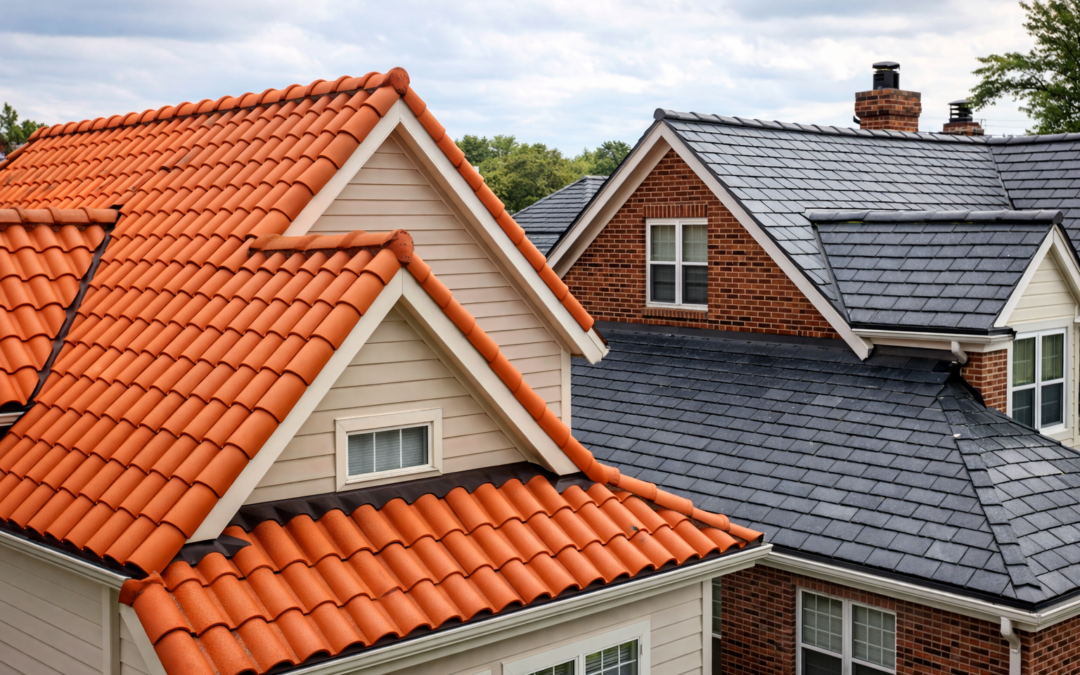
What’s the difference between tile and slate roofs on properties in Cornwall? Which is better? This comparison examines roof types and answers key questions: What materials are involved? How much do they cost? What’s their expected lifespan? How do they deal with Cornwall’s weather? How much maintenance is needed? What do they look like? Which material suits Cornwall properties best?
Tile and slate roofs are examined in terms of material, cost, durability, weather, maintenance, aesthetics, and suitability for Cornwall.
Tiles are either clay or concrete. They can be flat or curved in profile and laid in either an overlapping pattern or an interlocking system. Tiles are installed on timber battens set a prescribed distance apart to drain water, typically 300 mm in the UK. Fittings include lead- or tile-rolled valleys, vented hip ridges, and secret gutter trays. Cornish properties generally use concrete tiles, often reddish in hue, laid on a basic timber structure with rafters spaced up to 900 mm apart. Clay tiles are used for listed buildings, but they are more brittle and prone to breaking than concrete tiles.
What are tile roofs
Roof tiles are waterproof materials made from clay or concrete, either flat or curved. Tile roofs have been around since 3000BC to keep buildings dry and stand out for their ability to provide an interlocking, waterproof roofing system. Roof tiles are installed in rows from the top to the bottom of a roof, with overlapping rows covering the joints of the rows directly below. Pozi-headed nails are used to install the majority of roofs in the UK, while hook systems are more commonly seen on shingle tiles. Roof tiles range in size, but half-baton lengths of approximately 450mm x 300mm are commonly found in the UK. Additionally, double Roman tiles are one of the most common clay tile types in the UK and are half-baton lengths of approximately 420mm x 330mm.
While roof tiles can be made from a range of materials, the most common in Cornwall are a combination of clay and concrete. Clay is traditionally fired in a heavy kiln, while concrete tiles are often thinly cast and cured in moulds. All these materials are hard and dense, allowing the roof to weather satisfactorily in low-temperature conditions. A major advantage is their smooth surfaces, as moss tends to be washed off by rainwater rather than taking root and holding moisture against the tile. However, even in dry or shaded areas, moss can still flourish, and the inspection of moss growth should therefore form part of any periodic roof inspection.
What are slate roofs?
Slate is a stone that has been split into sheets, usually thinner than 10 mm, naturally producing a flat surface. Slate roofs have a traditional, timeless elegance. Slates are usually installed in an overlapping pattern secured with copper, lead or stainless steel nails with zinc-covered heads. Alternatively, they are fitted into hooks. The majority of slates measure 600 mm long and 250 mm wide, although larger slates are becoming more common.
In the UK, slates are typically made from blue-grey, grey-green, green or brown slate that is quarried in Wales, Scotland and Northern Ireland. These slates are long-lasting, highly resistant to weathering, decay, and frost, and have very low water absorption for a natural stone. They are also the only roofing material with an expected lifespan of more than 100 years. However, slate can become fragile with age, and cracked slates are common and cheap to replace. A further common cause of invisibly affected slates is fatigue failure of the copper nails; they become brittle and lose their tensile strength long before corrosion normally sets in.
Durability and longevity
Tile roofs typically last 50 years, while well-maintained slate roofs can exceed 100 years. Tiles crack, slip, or lose securing fittings; slates can crack and suffer nail fatigue, leading to slipped slates. Maintenance level significantly affects a slate’s life expectancy.
Tile roofs generally last 50 years, while slate roofs can last well over 100 years with proper maintenance. The common failure modes of the two materials vary. Tiles tend to crack on impact or lose fixing components, allowing individual tiles to slip or fall completely. On slate roofs, slates may also crack, while fatigue of the nails or other fixing elements can allow slates to slip down the roof and upset the natural drainage pattern.
Maintenance regimes can significantly impact the longevity of slate roofs. The relatively high capital cost of a slate roof may well justify a lower maintenance regime, but the trade-off is not straightforward; tiles are less costly to replace than slates. With a robust maintenance regime, slate tends to outlast tile by a significant margin.
Weather and climate considerations in Cornwall
A roof is the first line of defence against the weather, so it must be carefully evaluated in terms of its geographic location and environmental considerations. Cornwall’s location at the south-western tip of the UK means it is subjected to southwest prevailing winds. This leads to stormy winds and heavy rain, particularly during the winter months. The relative geographical position of the ocean puts Cornwall at the mercy of the North Atlantic Ocean, which collides with the warmer, more moist atmospheric currents over the Mediterranean.
This results in heavy winter rainfall and mild, but damp, summer weather. The sea air contains salt particles and is laden with moisture, which contributes to the humidity. Both warm and damp climates promote the growth of algae and moss on roof surfaces, requiring regular maintenance. Wind induces saline spray, a phenomenon associated with coastal exposure that contributes to the corrosion of all exposed building elements. Wind carries airborne pathogens, including fungal spores and viruses, that can affect both slate and tiled roofs. Frost risk is limited to higher ground, where altitude increases. Thermal movement and frost action are inevitable and are the main factors behind the expansion and development of cracks.
The building’s location strongly influences the character of the roofs. Roof structures should incorporate sufficient slope to prevent the accumulation of salt and other particles, which can cause corrosion. Tile and slate roofs are widely accepted as the primary covering for buildings located along the coastal area, as they have the integrity to resist the effects of a saline environment.
However, these roofing materials should be carefully examined, as both show signs of decay before their expected lifespans and may not be covered by the manufacturer’s warranty. Moss on tiles provides a warning signal of a failing cover. Too much moisture on slate surfaces has a twofold effect: the fungi on the nail penetrate the tangential plane of the slates and result in premature cracking of the hole. At the same time, excessive exposure may cause the nails to fatigue, leading to cracks along the horizontal plane.
Cost and value
Tile roofs are usually cheaper to install. Slate roofs last longer and contribute more to property resale value. Costs are also affected by requirements to repair or replace broken items. A regular maintenance routine helps avoid hidden problems that lead to an early exit from either roof type.
Tiles cost about £60 per square metre, including materials and installation. This compares to £90 to £120 for natural slate. Installing high-quality slate is a more expensive option, especially if repairs require it or a complete replacement.
Slate roofs generally offer a better long-term investment for property owners. If well-maintained, they have a lifespan double that of good-quality tiles. Almost all roof types require inspection at regular intervals. In Cornwall, a professional roof inspection is a worthwhile annual investment, especially for coastal properties and older buildings. As with other elements of a property, roof maintenance can be temporarily neglected, but early attention to hidden faults usually makes a major difference to the cost of replacement. For both roofs, the areas that often need attention are listed here.
Maintenance needs
Routine maintenance is essential for ensuring the longevity and optimal appearance of both tile and slate roofs. For tiles, checks should focus on cracked tiles, loosened fittings, moss build-up, and the condition of flashings, valleys, and ridge capping. For slate roofs, important items to assess include cracked or broken slates, fatigue and corrosion of nail fixings, the condition of any hook fixings, and the state of flashings. Tinting for additional visual appeal is possible, but care should be taken to avoid changes that would prevent rainwater from properly draining from the roof surface.
In Cornwall, roof maintenance is not always straightforward due to accessibility issues presented by either height or the property’s sea-facing elevation. Work on these elevations should therefore be carried out by roofers with high-access equipment and experience in working at height. For both tile and slate roofs, repair and replacement work is generally carried out by the roofer in short order if they have the necessary materials and are free to do so.
Aesthetics and style
Tile roofs typically have a warmer colour tone and a smoother surface than slate roofs. Tiles are artificially produced, so their available colours often include bright reds and oranges. Slates obviously come in shades of grey, blue, and sometimes green. Unlike tiles, the colour of slate comes from nature, rather than the dye tables of a factory. Thus, slate tends to suggest a cooler, more restrained palette, even if it is sometimes very colourful—especially when spotted with rich, dappled markings. Tiles, however, can be produced in a wide variety of shapes and textures. Some tiles imitate the look of slate by appearing to be a re-dressed natural product.
Portrayal in planning documents can also be a factor in choosing between tile and slate. An abundance of low-key grey slate lends a village a particular regional charm. Likewise, a uniform clean-up of broken slate and re-roofing with new exposed-fix slate can lose much of the character of an old district. Planning authorities in urban areas where affordability is the prime issue can be less concerned about this. In such cases, and therefore in general, tile is more likely to be specified for new work. Property type is also a guide to the material choice; property more modest in size usually appears plain-pantiled or with the fishscale effect of crested ridge-tiles. Urban areas strongly favour clay and concrete tile; rural areas in Cornwall like the softer look of natural stone slate.
Environmental impact
Tiles and slate differ markedly in damage potential during production. Tile production typically incurs substantial CO2 emissions, fueled by extensive clay mining and energy-intensive high-temperature firing. However, concrete tile manufacture offers a relative environmental advantage, as cement requires less heat than traditional tile ingredients. The limited, localised geographic range of slate minimises transportation emissions, offsetting the typical quarrying costs of natural products.
Environmental difference, however, is also reflected in disposal considerations at the roof’s end. While clay and concrete tiles are difficult to recycle, natural slate can be reused, adapted, and downcycled with relative ease. Local reintegration into properties diminishes further footprints. For transport costs, slate is especially advantageous along the south coast of England and Wales. North Cornwall properties generally benefit similarly.
Choosing the right roof for your property
Whichever roof material you choose, it must be suitable for the roof slope angle, the weight it can support, and the structure beneath it. Properties in more exposed areas may also require a roof design capable of withstanding higher wind forces, such as a tile roof with a lower pitch. Slate roofs are heavier than tiled roofs, which makes installation more complex.
Maintenance considerations can also help narrow the choice. Tiles usually have a lower initial cost, but they can be subject to damage that requires repairing or replacing individual tiles, which is usually straightforward. The long-term cost can therefore swing the other way depending on maintenance and long-term durability. If that maintenance buy-ahead or buy-cheaper decision is swaying you towards slate, be mindful that the roof needs to be free of any gutters’ residue and of excessive moss growth so the gutters remain clear. Resale concerns may also influence the choice. Roof style, type, and material can affect the asking price, especially in locations where match and continuity with buildings and surroundings are considered.
If the choice is between a new roof and tiles that are cheaper, and the property is near the coastline or under the flight path of the prevailing wind, a tiled roof will have a shorter lifespan, and the return may not justify the difference. A slate roof will not look out of place in a property such as a period terrace house, but it may be considered heavy in relation to style and proportion for a cottage. Brick expansion size, often near wildlife areas, may require planning permission from the local authority.
Practical tips for installation and care
For maximum longevity, tile and slate roofs should be installed by professionals. Ideally, the roof should be inspected at least every five years. Also, any major works should be approved by a Cornwall Council conservation officer. Even if it’s not a listed property, the local authority will usually want to check that the planning policy is being followed.
The best time of year for fitting is either early or late summer. The rain eases, but the wind is not yet strong. Once the roof is installed, routine maintenance will help to avoid costly repairs. Moss should be cleared from the tiles and their fittings when it’s thick. The gutters should be kept clear and checked for blockages at least twice a year. Any broken tiles should be replaced as soon as possible. With these checks in place, a tile roof can last fifty years or more. In Cornwall, however, the key consideration remains winter weather.
Conclusion
This analysis has distilled the main comparisons between tiled and slate roofs for properties in Cornwall. When deciding which material provides the best roof, the following simple rules of thumb may help guide the decision. First, for properties with a roof pitch of less than 40 degrees, a tile roof is typically much cheaper to install, though long-term cost comparisons should factor in tiles’ relatively short lifespan. Second, on balance, aesthetics lead a greater percentage of property owners to choose slate than tiles, so if both options are reasonably close together in terms of cost, slate may be preferable for its longer life, especially given Cornwall’s damp and salty maritime climate. Third, while maintenance can be a consideration for slate roofs, it is often neglected, so reducing the maintenance burden may be desirable. To make a tile roof somewhat weatherproof and limit future maintenance, double-check the bedding mortar and run a high-power jet wash along the valleys every couple of years to keep them clear of silt, leaves and debris, rather than waiting for blockages to cause overflow damage. Tiles should also be visually checked over a ladder once per year for cracks, and any loosened fittings resecured—moss growth should be actively controlled either by a 10-minute visual scan once per year or by a spray of a moss-control solution every autumn, as needed.
For any property that receives regular maintenance, there is one clear maxim: whatever the material, get local professional tradespeople to regularly inspect the whole roof and anything nearby, then maintain it all in good order. An early installation, preferably during a late April dry spell, is always to be hoped for, and ideal conditions are dry, sunny weather. It is wise to ensure that the roof and property as a whole remain free of all green growth, and that all gutters are cleared of blockages and washed free of silt at least once per year. Cornish properties with a slate roof are best kept snow-free, but the best plan for a tile roof is to use a stiff brush to clear it after any heavy snowfall to guard against the risk of the crisp, brittle tiles snapping under their own weight or the weight of the incoming thawing water.