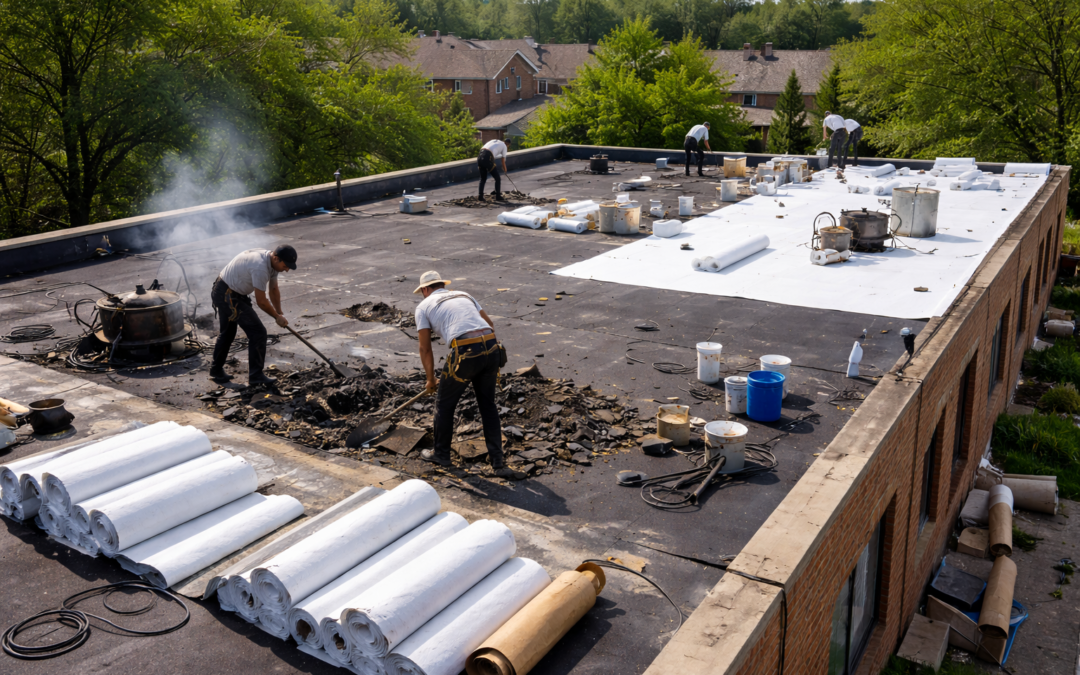
A home’s flat roof might leak. These leaks can damage the house’s interior and need fixing. Leaks are often the result of poor drainage or old membranes. Regular maintenance reduces leaks and makes repairs less frequent or costly.
Flat roofs are roofing surfaces that slope less than 1 in 80. The angle is gradual enough that the roof is visually horizontal. Flat roofs are found worldwide. They are often less attractive than pitched roofs and less common in the UK, but they have a more extended history in hot, dry regions. In Devon, flat roofs are found over entrances, porches, and garages; dock buildings; shelters in gardens and public parks; commercial premises; and residential flats. The roof covering is almost always a single-ply thermoplastic or synthetic rubber membrane. With no pitch, gravity provides little help in keeping roofs leak-free.
Water drained from the roof collects in gutters before reaching the downspouts. If the gutters are blocked, debris-strewn, or designed to seem invisible, water pools on the roof surface rather than flowing over the edge. Standing water is the enemy of flat roofs. Standing water is much heavier than rare summertime rain and usually lasts for several days or weeks rather than just hours. As the roofing membrane ages, standing water becomes increasingly problematic. When its weight flattens raised areas of the flat roof, ponding water stresses joints, connections, and seals.
Common Causes of Flat Roof Leaks
A variety of issues can cause leaks in flat roofs. Poor drainage leads to standing water, which eventually reaches the roof layers or runs over the edges. Over time, membranes wear out. Cracks or breaks in the seams, joints, or seals around edges, penetrations, and flashings can lead to gutter problems. Ponding water contributes to roof-weight stress, and edge conditions affect leakage risk.
Standing Water and Blocked Gutters
Ponding water is the primary cause of leaks. This is supported by evidence from insurers and surveyors that flat roofs can leak for various reasons. A simple check is to look for standing water after heavy rain. If any collects around drains, gutters, parapets, or at low spots, then water is often admitted through layers, seams, or edges. It also means the gutters are not working. Water spilling over cannot reach the outlet, so it runs down the roof.
Membrane Damage or Wear
Any sign of damage or wear to the roofing membrane itself is a concern, as it provides the first line of defence against leaks. Damaged membranes open a gap for water to enter the construction. Typical wear patterns include surface cracking and crazing, erosion at corners and edges, and ply splitting in bituminous flat roofs.
Poor Drainage
When a flat roof fails to drain properly, water will stand for long periods on its surface. Although EPDM, GRP and felt roofing systems don’t mind being wet, water getting through the membrane and into the layers below, or leaking over the edges into the walls or soffits, can still cause severe damage.
Blocked gutters often exacerbate this condition. Rainwater constantly drains to the nearest joint or lowest point, and at those points, the weight of the standing water can be significant. It only takes a couple of inches of standing water to equal a ton. This stresses not only the roof itself but also any joints and seals in the membrane. If these joints hold the water for an extended period, the risk of failure can grow exponentially. The combination of previous leaks into the roof layers and excessive weight can lead to complete roof failure, often resulting in the loss of both the roof and the home.
Damaged or Worn Membrane
Damage or wear to a flat roof’s waterproof membrane, which allows water to reach the layers below, is a common cause of flat roof leaks. Flat roofs typically have at least two thin, waterproof layers forming a barrier against moisture. These layers may be a “built-up” combination of thick felt, bitumen, and gravel, or a continuous single-sheet membrane. Standard membranes are glass-fibre-reinforced polyester or ethylene-propylene-diene monomer (EPDM), a flexible rubber sheet. As these materials age, become brittle, or are stretched by heat and pressure, they can crack, split, break, or tear. Such damage may be readily apparent when viewed from above or below through a roof-space opening. However, damage is not always visible, and leaks can occur even in apparently sound areas.
Depending on the severity, leaks from such damage can be straightforward to fix by patching or by replacing affected panels. It is also advisable to carry out work at the same time as any other roof repair. Joint or sealant failure is a related concern, focusing on the fixings or seals around penetrations. These joints remain the most vulnerable areas of a flat roof, especially where roofers have cut around pipes, chimneys, or other structures protruding through the roof.
Faulty Seals and Joints
Seals and joints can fail in several ways. If a membrane runs to an edge, penetrates the roof, or meets a flashing, a seal is needed to keep water out. When the seal erodes or the membrane is not bonded adequately at these locations, it can become a path for water. In these areas, enough movement can create gaps where water can collect. Many of these places are critical to keep watertight. A failing seal around a pipe with drainage below the pipe, or around the base of a chimney where the wind can direct water into the joint, should be inspected regularly to check for leaks. Flashings that join the membrane have similar requirements.
Joints are formed where two pieces of roofing meet. Traditionally, bitumen rolls were placed end to end, and a bituminous adhesive was applied. The method relies on the adhesive making a bond that lasts. In modern single-ply membranes, joints are factory-finished, usually with a chemical that forms a bond when the surfaces are pressed together and remains active for some time after, because they will have been left agitated until the chemically-active surface has weathered. If two surfaces are not correctly bonded during installation, or if movement at the joint has caused a tear to form or open, water can run through.
Ponding Water
Standing water—the same thing that allows roofers to sit on a flat roof—is a standard feature, but should not persist for long. Any pool, no matter how small, places added loads on the roof layers, increasing the risk of hidden failure, disrupting the flow of rainwater runoff, and creating the potential for leakage. For example, a volume of water only 1 cm deep spread over a 10 m² area (roughly the size of the average garage) weighs 100 kg, approximately the weight of four static adults. Deformation of the roof membrane and joints may occur, and there is the potential for uncontrolled leakage if the pooling water runs over a joint or other weak point.
Even ponds which are empty most of the time are undesirable. Areas of flat roof that regularly pool water after rain provide ideal conditions for moss and lichen growth, which may accelerate membrane degradation, and what remains after evaporation is minimal. Any small quantity of water should drain off or evaporate very quickly.
Edge and Flashing Problems
Edge conditions and flashing details are particularly crucial areas where problems often appear. Incorrect drainage at the edges may cause water to leak into the roof layers or support structure. In many cases, flat roofs are installed with a slight fall to a gutter but without a parapet wall. With no side wall present, surface water drainage is entirely governed by the gutter’s adequate capacity. Should this become wholly or partially blocked by debris, water cannot escape from the roof in this area. Leaks may then develop within the layers or into the structure below. Leaks in these areas become particularly serious simply because any water backed up behind a blocked gutter may not only damage the roof layers but may also run down inside the support structure and possibly come out at a point some distance from the edge.
An easily overlooked but equally important detail is the flashing around any penetrations (such as chimney stacks, vents and service pipes) and the adjacent joints between the roofing and any upstands. Even a small gap at these points may cause water to leak into the structure. If there is movement in the structure, it may simply open an existing gap, which can develop into a leak; for example, movement can occur when heating and hot-water systems are drained down in winter. Similarly, radiant or direct heating may cause differential expansion in the structure. Movement of roof-mounted air-conditioning units and any other structure-supported equipment can cause stresses in the membrane at these points. Either the flashing and seal should be made sufficiently flexible to accommodate this movement, or they should be carefully inspected for signs of wear and possible future failure.
Effects of Leaks on Homes
A flat roof leak can allow water to enter a building, damaging interior surfaces and possessions and creating damp conditions that encourage mould. If water penetrates the flat roof’s insulation layers, the insulation may also be damaged. Other consequences may include higher heating bills and the risk of a roof collapse if the leak goes undetected and causes enough damage.
Water entering the roof supports or into the ceiling just below the roof may manifest as water stains, bulging plaster or paint, peeling wallpaper, or dripping water; a combination of these indicators suggests a serious problem. If the flat roof is well insulated, the drop in temperature at the roof edges can lead to condensation in winter. Water in walls or ceilings can create damp conditions that lead to mould or mildew growth.
Fixes and Preventive Steps
Maintenance contractors can fix many of the issues listed above, or leaks can be stopped temporarily until permanent repairs can be made. Quick fixes include laying a tarpaulin over wet areas, sealing small holes with sealant or flashing tape, and using plastic sheeting stretched tightly with wooden battens to cover leaky areas.
Professional repairs are ideally carried out from scaffolding to ensure safety and restore the roofing system to a fully watertight state. Damaged areas of the membrane can be replaced and sealed with hot-air, torch-on, or adhesive methods. Flashing and other joints should be examined and re-sealed as necessary. Damaged flashings and membrane around penetrations should be replaced, and any loose joints in the membrane re-bonded.
Routine maintenance helps to prevent leaks. Drains should be kept clean and free-flowing at all times, and the area underneath them should be inspected periodically for water staining. At least once a year, especially after winter, the entire roof surface should be checked. Particular attention should be paid to expansion joints, gutters, and areas around pipe flashings where dirt, moss, and vegetation often accumulate, creating entry points for water. Expansion joints should be re-sealed as necessary, and localised repairs and touch-ups of defective areas carried out as required.
Quick Temporary Measures
Quick temporary measures can help to stop or slow leaks until a proper repair is carried out. Using internal buckets and containers is a standard short-term solution. Before repositioning, it is good practice to make a temporary repair to the leaking area of the roof to help limit further damage and degradation to the building’s interior.
To stop or slow leaks until proper repairs are carried out, the following temporary measures may be considered: Tarp a section of the roof using a weighted rope lined with a cut section from a heavy pipe at each corner, or a dripping polyethene sheet fastened to the membrane. Alternatively, tarp continues across the roof using a weighted rope at pitches. A tarp can also be lined with a heavy-gauge animal water trough.
Professional Repairs
Professional repair methods address leaks by fixing the underlying problems. If a membrane is punctured, a new section can be added or the affected area patched. A failing seam can be resealed or reinforced, while damaged flashings can be repaired or replaced.
A regular maintenance routine will minimise the risk of leaks. Gutters and drain outlets should be cleared regularly, sealants inspected and replaced as required, and joints around break-ins checked and resealed whenever necessary.
Maintenance That Helps
Standard maintenance to reduce flat roof leaks includes: clearing gutters and other drainage outlets; inspecting membrane and edge seals; resealing vulnerable joints; and checking for signs of damage or wear. Such checks allow issues to be fixed before they become significant.
Blocked drains, reducing the roof’s natural drainage capacity, encourage water to pool. Standing water, especially if it persists for a long time, can cause excessive weight that stresses roofing and seals. Keeping gutters and drains clear reduces the chance of internal layers becoming saturated and of heavy loads forming.
Membrane repair is complex; small holes, thin areas, and wear marks can be hard to spot, particularly when the roof is high. Regular inspections help identify signs of damage or wear that could lead to leaks. Edge seals—along parapets or walls—also need regular checking; leaking water can damage the covering, and sometimes the roof may seem machine-made yet contain many joints.
Standard maintenance to reduce flat roof leaks includes: clearing gutters and other drainage outlets; inspecting membrane and edge seals; resealing vulnerable joints; and checking for signs of damage or wear. Such checks allow issues to be fixed before they become significant.
Choosing a Local Roofer in Devon
Devon homeowners facing flat roof leaks may need to hire a local roofer to repair them. The steps I’ve included below will help you choose a reliable contractor. First, check that the tradesperson holds the required licenses. Next, read online reviews to assess the quality of the work. Look out for tradespeople with extensive positive feedback. Page-for-page, too many bad ratings should raise concerns.
Contact three roofers known to fix flat roof leaks. Ask them to visit, inspect the problem, discuss options, and give estimates. A reputable tradesperson will provide a written quote, and one should be selected based on price, past feedback, and rapport—an established roof repair business with proven experience is less risky than hoping for a bargain from an unknown company.
Cost Considerations and Planning
When planning flat roof repairs, a budget is essential. Like any other work, roof repairs vary in cost, with several factors affecting the final price, including the materials used, access conditions, and roof complexity. Carrying out repairs sooner rather than later can help keep costs below those associated with more extensive damage.
Setting an estimated budget before contacting local Devon roofers can be helpful. For many common repairs, the following cost guides apply:
– Routine repairs to resume short-term water-tightness and slow water ingress—continuing similar work carried out previously by others—can range from £100 to £250.
– Minor repairs of holes, tears, and blisters can range from £250 to £500.
– Repairs to joints, seals, flashings, gutters, and upstands can range from £250 to £1,000.
– Repairs to larger blisters or splits, where the core structure is sound, can range from £500 to £1,500.
– Repairs to ‘zipped’ roofs can range from £1,000 to £2,000.
– Re-roofing, including closed-cell systems, can range from £3,500 to £8,000.
When to Replace a Flat Roof
Flat roofs remain in place for years. Eventually, most flat roofs, though, need replacement. Signs that replacement is due include:
• Age: The typical lifespan for a flat roof is a couple of decades. That said, some membranes can last much longer—with few issues along the way. But if the roof is approaching or has passed its expected lifespan, replacement should be considered before problems arise.
• Repeated leaks: No flat roof is leak-proof. Every flat roof requires an occasional repair. But if the roof has needed multiple repairs in a short period, or it is leaking into the building after every heavy rain, well, that is not normal. And the need for repeated repairs suggests replacing the roof is a more sensible option.
• Membrane failure: Roof membranes may last for years. But they can also break down with age and the constant battering they take from the elements. The result is a porous, brittle surface that allows moisture into the layers below. A roof like this can leak even during light rainfall.
• Structure concerns: Flat roofs with sagging surfaces may need replacement, particularly if the sag is severe. A sagging roof fails to drain properly, resulting in ponding. And a sagging roof structure could pose a risk. So in situations like this, it is advisable to consult a qualified roofer to assess whether a complete roof replacement is necessary.
The question of roof replacement arises frequently, because it can be difficult to judge whether a roof is better repaired or replaced. In most cases, a straightforward repair is more cost-effective.
Conclusion
Flat roofs can leak for many reasons. Interior water damage often indicates a leak has developed, but identifying the source is essential. Prompt repair helps prevent further damage.
Common causes include: poor drainage that allows standing water; wear or damage to the membrane, especially around seals and joints; ponding; and problems with edges and flashings. Water sitting on the roof, or flowing from blocked gutters, may reach the roof layers. Signs of damage indicate that water can penetrate the roofing. Faults in seals and joints at the edges, around penetrations, and at flashings can create gaps or allow movement. Ponding water can be heavy enough to stress the roof and its seals. Poor edge conditions and failing flashings can direct water to vulnerable areas.